When to Choose MoR Over a PSP: A Practical Guide for SaaS and Digital Products
Learn when to choose a Merchant of Record (MoR) over a Payment Service Provider (PSP). Practical guidance for SaaS and digital product companies scaling globally, with clear tradeoffs and decision checklists.
Choosing between a Merchant of Record (MoR) and a Payment Service Provider (PSP) is less about which is “better” and more about which model matches your risk tolerance, compliance burden, and global growth plans. A PSP helps you accept payments; an MoR becomes the legal seller and typically takes on tax, compliance, and consumer payment obligations in exchange for a higher fee and less control.
This guide explains when an MoR is the right fit—especially for SaaS, digital goods, and subscription businesses selling internationally.
MoR vs. PSP (Plain-English Definitions)
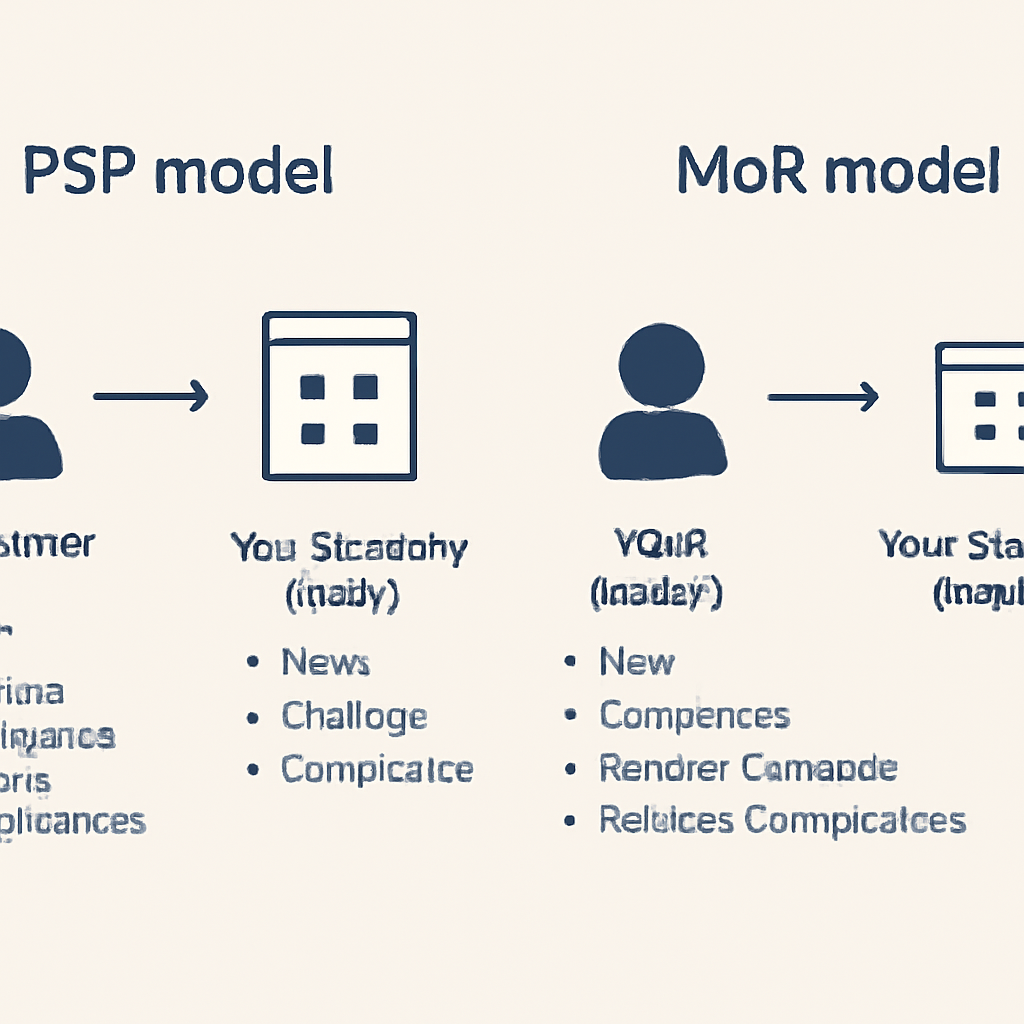
A PSP (Payment Service Provider) processes payments on your behalf (e.g., card payments, wallets). In most setups, you remain the merchant/seller of record: you set the terms of sale, contract with the buyer, and typically handle sales tax/VAT/GST obligations, invoicing requirements, refunds/chargebacks policies, and compliance duties tied to selling in each region.
An MoR (Merchant of Record) is the entity that sells to your customer in a legal and tax sense. The MoR usually: (1) collects and remits applicable indirect taxes (like VAT/GST/sales tax) where required, (2) manages many local compliance requirements related to digital sales, (3) handles payment acceptance and often chargebacks/refunds processes as the contracting seller, and (4) pays you out net of fees, taxes, and refunds per the agreement.
In short: PSP = payments tool. MoR = seller-of-record business model that includes payments.
Choose an MoR Over a PSP When These Conditions Apply
- You’re selling internationally (or plan to soon) and don’t want to build tax compliance country by country.
- You need fast access to new markets without creating local entities or complex registrations.
- You sell digital products/subscriptions and want indirect tax (VAT/GST/sales tax) handled end-to-end.
- You have limited appetite for chargeback, fraud, and consumer payment compliance operational overhead.
- Your team is lean and you want a “sell globally” setup without hiring specialists for each jurisdiction.
- You want simpler customer checkout localization (local payment methods, currency handling) through one commercial relationship.
1) You’re Expanding Globally and Don’t Want a Tax and Compliance Program (Yet)
If you remain the seller using a PSP, you typically need to determine where you have indirect tax obligations (for example VAT/GST on digital services), register where required, collect the correct tax, issue compliant invoices/receipts, and file/ remit on time. That can be manageable in one country, but becomes operationally heavy across multiple jurisdictions.
An MoR is often the right call when global expansion is a growth lever and your business would rather “outsource the seller role” than build a tax + compliance function early. This is especially common for SaaS companies moving from a single-market product to global self-serve distribution.
2) You Need Speed: Launch in New Countries Without Local Complexity
A PSP can help you take a card payment from almost anywhere, but “being able to charge a card” is not the same as being operationally ready to sell in that market. Many businesses discover later that selling cross-border can introduce indirect tax exposure, customer receipt rules, and consumer protection obligations.
An MoR can be the best choice when time-to-market matters more than having full merchant control from day one. You can test demand in new regions, price in local currencies, and offer widely used payment methods—while keeping internal operations focused on product and growth.
3) Your Product Is Subscription-Based and You Want Fewer Billing Compliance Headaches
Subscriptions add recurring billing, renewals, proration, refunds, failed payments, and chargeback workflows. If you’re the seller (PSP model), you typically need robust processes and customer communications that meet applicable consumer payment rules, plus the tax handling for recurring digital services where applicable.
An MoR is often a better fit when subscriptions are central to your business and you want a consolidated approach to recurring billing operations—especially in multiple countries.
4) You Want to Reduce Chargeback and Fraud Operations Burden
With a PSP, you can configure fraud tooling and chargeback responses, but the operational responsibility often sits with you. That includes evidence collection, response deadlines, customer support alignment, and sometimes deciding how generous to be on refunds to protect dispute ratios.
An MoR can make sense when you prefer the seller-of-record to manage these processes at scale. This can be valuable if you sell lower-priced digital items where the time cost of disputes is disproportionately high.
5) You Have a Lean Team and Need an End-to-End Commercial Wrapper
Early-stage or product-led growth teams often don’t want to assemble a full stack of payments, tax calculation, invoicing, fraud tooling, and compliance operations—then maintain it as rules change.
If your priority is minimizing operational overhead, an MoR model can be attractive because it bundles many “sell globally” responsibilities into one provider relationship.
6) You Sell Digital Goods/Software Where Indirect Tax Rules Commonly Apply
Digital products and electronically supplied services frequently trigger VAT/GST/sales tax considerations depending on customer location and status (consumer vs. business). Determining the correct treatment can involve collecting location evidence, applying the right tax rate, and issuing appropriate tax documentation.
An MoR is often chosen when you want these obligations managed as part of the selling layer, rather than built into your own finance stack.
Tradeoffs: When a PSP May Be the Better Fit
An MoR isn’t always the right answer. A PSP may be better if you strongly prefer to stay the direct contracting seller and keep maximum control over the checkout, pricing structure, invoicing format, and customer relationship details. You may also prefer a PSP if you already have mature tax, legal, and finance operations—especially if your sales are concentrated in a small number of jurisdictions.
- You want full control over the legal terms of sale and customer contracting entity.
- You have an established tax compliance program and prefer to keep it in-house.
- You need highly customized payment flows or a deeply integrated enterprise billing system.
- Your business model requires direct merchant control for reporting, reconciliation, or customer experience reasons.
Decision Checklist: MoR Signals vs. PSP Signals
Use this quick checklist to pressure-test your decision.
- Choose MoR if: you’re going multi-country quickly; you don’t want to manage registrations/filings; you want a bundled approach to taxes + payments + risk ops; you’re optimizing for speed and simplicity.
- Choose PSP if: you’re staying mostly domestic (for now); you want to be the seller everywhere; you’re equipped to manage tax/compliance; you need maximum checkout and billing control.

Key Questions to Ask Any MoR Provider
Not all MoR offerings are identical. Before choosing, confirm how the provider handles the specifics that matter to your business model.
- In which countries/regions will the provider act as MoR for my product type (digital goods, SaaS, services)?
- How are refunds, chargebacks, and disputes handled—and what data do I receive?
- What does the payout and reconciliation process look like (timing, currency conversion, reporting)?
- How are taxes calculated and documented (receipts/invoices), and what customer information is collected at checkout?
- What payment methods and currencies are supported in my target markets?
- How is customer support split between my team and the MoR (especially for billing issues)?
- What are the contractual boundaries: who sets pricing, terms, and cancellation policies?
- What is the onboarding timeline and what technical integration options exist (API, hosted checkout, subscriptions)?
Common Scenarios Where MoR Is a Strong Choice
- A SaaS company moving from U.S.-only to selling across Europe and APAC.
- A small team selling digital downloads globally without a finance department.
- A subscription app prioritizing local payment methods and quick market entry.
- A creator tools platform that needs to reduce dispute handling overhead across many countries.
Bottom Line
Choose an MoR over a PSP when global selling speed, reduced compliance workload, and operational simplicity matter more than being the direct seller everywhere. If you’re expanding internationally, selling subscriptions or digital goods, and want taxes and selling obligations handled as a package, an MoR model is often the most practical path.